


Morning Read: Endangered owl advocates clash with North Country developer
by Brian Mann on October 10th, 2011
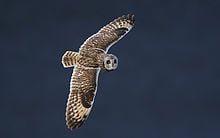
A short eared owl in flight (Photo: Wikipedia)
The Albany Times Union has a teaser story up today about a clash between a housing developer and advocates for the short-eared owl in Washington County.
A stretch of Washington County grassland is the center of a turf war of sorts between advocates of an endangered owl and the would-be developer of a housing project.
The issue also puts to the test new state regulations designed to protect endangered species like the short-eared owl.
Full details won’t be posted by the T-U until later in the week, but a couple of different websites exist describing the Washington County Grasslands Important Bird Area, a 13,000-acre parcel of private farmland in Fort Edward, Kingsbury and Argyle.
Audubon New York, The Nature Conservancy and Agricultural Stewardship Association have been working with New York State D.E.C. to conserve this vital habitat through conservation easements or land purchases from willing sellers. However, the remainder of this core area remains unprotected.
A Winter Raptor fest is planned at the site this March. I’ll post more about this story later in the week.
Tags: economy, environment


There have been several stories related to this in the Post Star over the years. If their website search function was better I would post more links here.
http://poststar.com/blogs/the_wash/hey-avid-bird-watchers/article_fa09cfa0-ef5c-5378-8cfe-fd38f564287c.html
Thanks, KHL. Not sure how I missed hearing about this, or seeing it in the P-S.
–Brian, NCPR
I don’t think the Short Eared Owl is “endangered”??
Paul, I don’t know why the New York State Department of Environmental Conservation didn’t check with you before they declared the short-eared owl to be endangered within in the state, but these things happen.
http://www.dec.ny.gov/animals/7080.html
You should let them know that they’re wrong.
Walker, thanks I looked at some other sites and they didn’t have it listed as endangered. I should have looked there first.
Save the sarcasm.
It looks like their breeding areas have expanded since 1974 including into Washington county. That expansion could be due to the abandonment of many farm fields as agriculture has declined in NYS.
According to the DEC site:
“Most biologists believe reforestation and the loss of open habitats are largely responsible for this decline.”
This is probably a bird that never inhabited any of the areas east of the Appalachian mountains prior to colonial settlement.
The area where I live in the finger lakes was probably much better habitat for this bird around the turn of the century when it was much less timbered than it is today.
If this area is to remain as good SE owl habitat it will need to be kept as open land. I wonder how they hope to do this. The trees will recolonize. This isn’t the prairie ecosystem.
From the DEC site: “The conservation of short-eared owls in New York depends on protecting relatively large, open sites that support small rodents. Except for a few large marshes, most of the nest sites recorded in recent years have been found on farms, typically in active hayfields or pastures where the nests and young birds are sometimes mowed or plowed. Once abandoned, agricultural sites rapidly become unsuitable for owls because they succeed to woodlands or are replaced by development. In order to protect short-eared owls it will be necessary to identify suitable nesting sites that can be managed for small rodents and owls. Such management will likely have the added benefit of protecting other imperiled grassland birds with similar habitat requirements.”
Paul, you’re right that little (apparently) can be done to prevent the loss of farmland. But we do have large marsh areas, which thankfully are now pretty well protected. I wonder if DEC contemplates actively keeping some sections of the Grasslands area from reforestation.
“I wonder if DEC contemplates actively keeping some sections of the Grasslands area from reforestation.”
Yes, that is my question. I agree marsh areas will provide habitat that is probably naturally sustainable. But the natural state of most of the uplands in this part of the country is pretty much covered in trees.
This owl has taken advantage of the changes that came with agricultural development. Simply protecting these areas will not preserve that habitat.
The spotted owl lives in old growth forest to protect that type of habitat you simply don’t cut the trees. Here it is more difficult. Preservation of natural grassland prairies out west I am sure has helped these birds to some extent.
“I wonder if DEC contemplates actively keeping some sections of the Grasslands area from reforestation.”
You can do this but it raises the question of whether we want to “manage” an area to keep a species here that we would not have under natural conditions.
We have made these kind of decisions in the past sometimes with unwanted consequences.
I would vote for it but I am biased in that I would like us to preserve upland game bird habitat that we are quickly losing. This would be a step in that direction.
“You can do this but it raises the question of whether we want to “manage” an area to keep a species here that we would not have under natural conditions.”
Paul, I suspect “natural conditions” is much less of a steady-state than your comment suggests– take post-forest fire conditions, natural in many cases, that favor certain species over others until regrowth occurs. So when we suppress natural forest fires, we have meddled with a flow of “natural conditions”. States like Florida routinely conduct controlled burns on state lands to reproduce the natural effects of the fires that have been suppressed.
I agree with what I take to be your basic premise, that such decisions are anything but straight forward, and need to be thought through pretty thoroughly. But I think DEC is getting pretty sophisticated about such stuff. Hope so, any way!
Why would someone give the above comment a thumbs down? You see some strange stuff on this blog.
Walker, I agree. Fire suppression is an unnatural thing. That assumes that the fire was started by a natural phenomena, not by human causes.
Large fires in the east when you had an old growth deciduous forest were probably almost non existent. When they would start they would probably not spread to much extent before they were naturally extinguished. The East is not like the West where fire is a very important part of the forest ecosystem.
But with all that said I am not against managing habitat for human use even if that is for wildlife viewing.